Change Leadership: The Kotter Collection (5 Books) by John P. Kotter & Dan Cohen
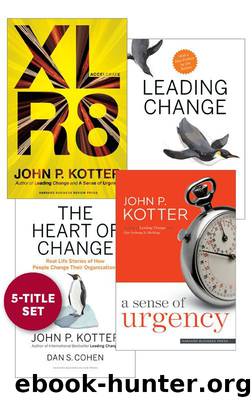
Author:John P. Kotter & Dan Cohen [Kotter, John P.]
Language: eng
Format: azw3
ISBN: 9781625277909
Publisher: Harvard Business Review Press
Published: 2014-08-12T04:00:00+00:00
The Flow of Change
The process of change involves subtle points regarding overlapping stages, guiding teams at multiple levels in the organization, handling multiple cycles of change, and more. Because the world is complex, some cases do not rigidly follow the eight-step flow. But the eight steps are the basic pattern associated with significant useful change—all possible despite an inherent organizational inclination not to leap successfully into a better future.
Evidence overwhelmingly suggests that the most fundamental problem in all of the stages is changing the behavior of people. The core issue in step 1 is not urgency in some abstract sense. The core issue is the behavior of people who are ignoring how the world is changing, who are frozen in terror by the problems they see, or who do little but bitterly complain. In step 2, the issue is the behavior of those in a position to guide change—especially regarding trust and commitment. In step 3, the core challenge is for people to start acting in a way that will create sensible visions and strategies. For people who know how to plan but have never devised a winning change vision, this behavior change is very big. In step 4, the issue is getting sufficient people to buy into the vision via communication. In step 5, it’s acting on that communication—which for some employees will mean doing their jobs in radically new ways. And so on throughout the process.
See, Feel, Change
Significantly changing the behavior of a single person can be exceptionally difficult work. Changing 101 or 10,001 people can be a Herculean task. Yet organizations that are leaping into the future succeed at doing just that. Look carefully at how they act and you’ll find another pattern. They succeed, regardless of the stage in the overall process, because their most central activity does not center on formal data gathering, analysis, report writing, and presentations—the sorts of actions typically aimed at changing thinking in order to change behavior. Instead, they compellingly show people what the problems are and how to resolve the problems. They provoke responses that reduce feelings that slow and stifle needed change, and they enhance feelings that motivate useful action. The emotional reaction then provides the energy that propels people to push along the change process, no matter how great the difficulties.
The stories presented throughout the book clarify this pattern, showing what can be done to enable the process. In chapter 1 (which deals with urgency), a procurement manager starts a needed change by creating a dramatic presentation. On the boardroom table he piles 424 different kinds of gloves that the firm is currently buying for its workers at dozens of different prices for the same glove and from dozens of different suppliers. First people are shocked, then the gut-level sense of complacency shrinks and urgency grows. It’s not just a matter of the data saying that changes are necessary in the purchasing process so people alter their behavior. Instead, it’s subtler and deeper. It’s a loud sound that catches attention in a day filled with thousands of words and dozens of events.
Download
This site does not store any files on its server. We only index and link to content provided by other sites. Please contact the content providers to delete copyright contents if any and email us, we'll remove relevant links or contents immediately.
Nudge - Improving Decisions about Health, Wealth, and Happiness by Thaler Sunstein(7711)
Deep Work by Cal Newport(7089)
Principles: Life and Work by Ray Dalio(6459)
The Doodle Revolution by Sunni Brown(4770)
Factfulness: Ten Reasons We're Wrong About the World – and Why Things Are Better Than You Think by Hans Rosling(4746)
Eat That Frog! by Brian Tracy(4543)
Thinking in Bets by Annie Duke(4229)
Hyperfocus by Chris Bailey(4124)
Visual Intelligence by Amy E. Herman(3787)
Writing Your Dissertation in Fifteen Minutes a Day by Joan Bolker(3731)
Ogilvy on Advertising by David Ogilvy(3627)
Hidden Persuasion: 33 psychological influence techniques in advertising by Marc Andrews & Matthijs van Leeuwen & Rick van Baaren(3569)
How to Win Friends and Influence People in the Digital Age by Dale Carnegie & Associates(3566)
How to win friends and influence people by Dale Carnegie(3479)
The Pixar Touch by David A. Price(3442)
Schaum's Quick Guide to Writing Great Short Stories by Margaret Lucke(3383)
Deep Work: Rules for Focused Success in a Distracted World by Cal Newport(3240)
Work Clean by Dan Charnas(3126)
The Slow Fix: Solve Problems, Work Smarter, and Live Better In a World Addicted to Speed by Carl Honore(3013)
